


AAPOD2 Image Archives
Avani Soares
Featured Astrophotographer on AAPOD2
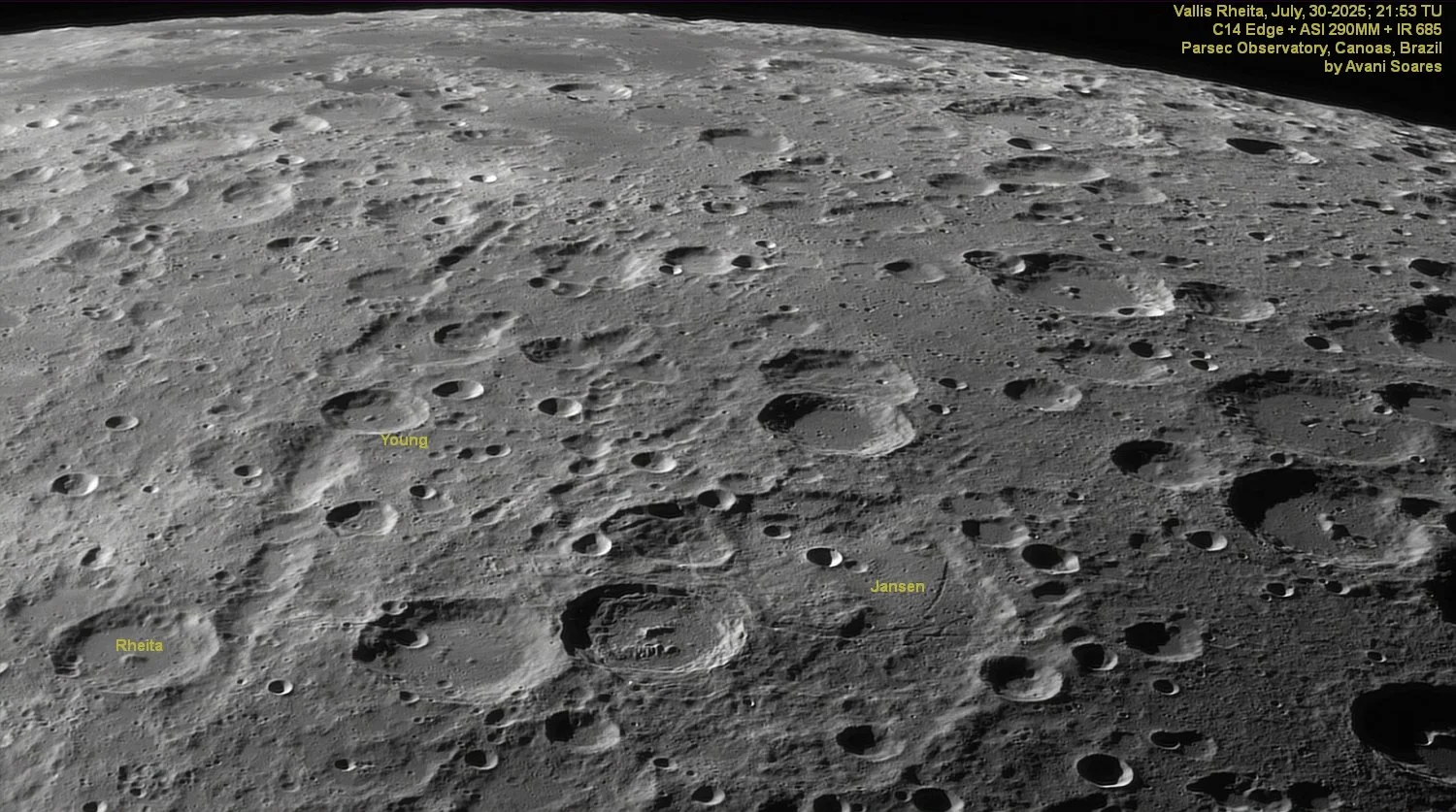
Vallis Rheita – Impact-Sculpted Lunar Valley from Brazil
Captured from Parsec Observatory in Canoas, Brazil, this high-resolution lunar mosaic showcases Vallis Rheita—one of the Moon's longest impact valleys—stretching across the southeastern quadrant of the near side. Labeled craters such as Rheita, Young, and Jansen mark the valley’s rugged path, each a witness to the Moon’s violent history. The image was acquired on July 30, 2025, using a C14 Edge telescope paired with an ASI 290MM camera and IR 685 filter.
Vallis Rheita measures 445 km long and up to 30 km wide, narrowing to 10 km at its southeastern tip. It likely formed during the same catastrophic event that created Mare Nectaris, when immense ejected debris rained down, carving out a chain of craters and valleys. One theory suggests the valley was gouged by mountainous fragments hurled from the impact site, while another posits a fractured pre-existing structure expelled as a crustal flow. Rheita is the second-largest such valley on the Moon’s near side, only surpassed by Vallis Snellius, which shares its radial alignment to Mare Nectaris.
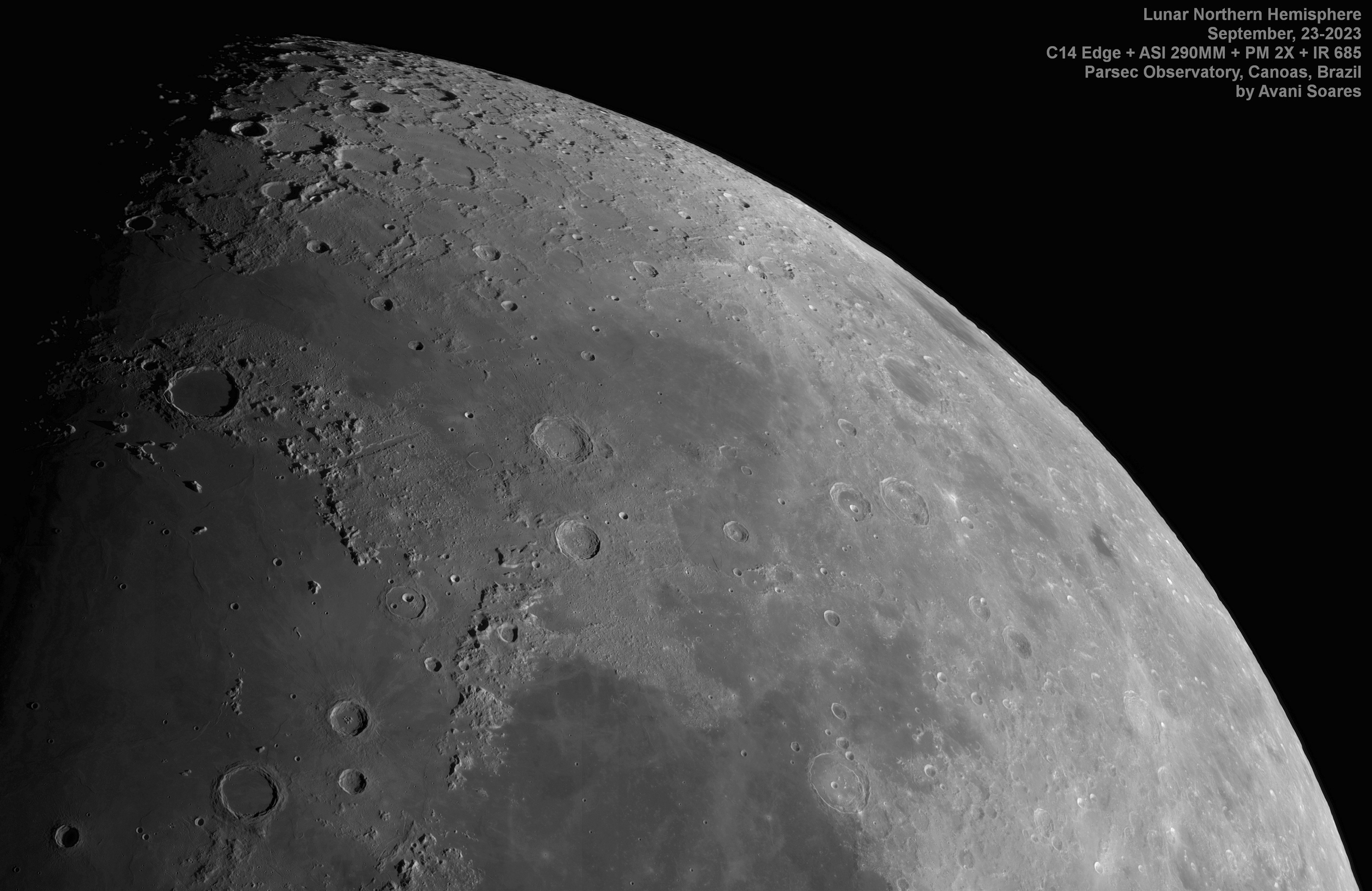
Lunar Northern Hemisphere
The northern hemisphere of the Moon is often referred to as the "Lunar Northern Highlands" or simply the "Lunar North." This region is characterized by rugged terrains, highlands, and numerous impact craters. Some notable features within the lunar northern hemisphere include the expansive plains of Mare Frigoris, the prominent craters Plato and Archimedes, and the rugged terrain of the Montes Caucasus and the Montes Alpes mountain ranges. The lunar north provides a diverse and visually compelling landscape for lunar observers and researchers alike.

Clavius and Moretus
Imaging telescope or lens: Celestron C14 EDGE HD
Mount:CGE Pro
Software: Fire Capture, AS!2, Photofiltre - Irfan
Filtro: Baader Planetariun IR Pass 685
Copyright: Avani Soares